

Creativity and training are deeply interconnected—training can significantly enhance creativity when it's designed to unlock potential, encourage experimentation, and provide practical tools. Here's a breakdown of how training can support and boost creativity, along with actionable methods:
- Teaches Creative Thinking Techniques
- Builds Creative Confidence
- Encourages Collaboration
- Improves Problem Framing Skills
- Creates Safe Spaces to Experiment
- Use game elements to drive creative behavior
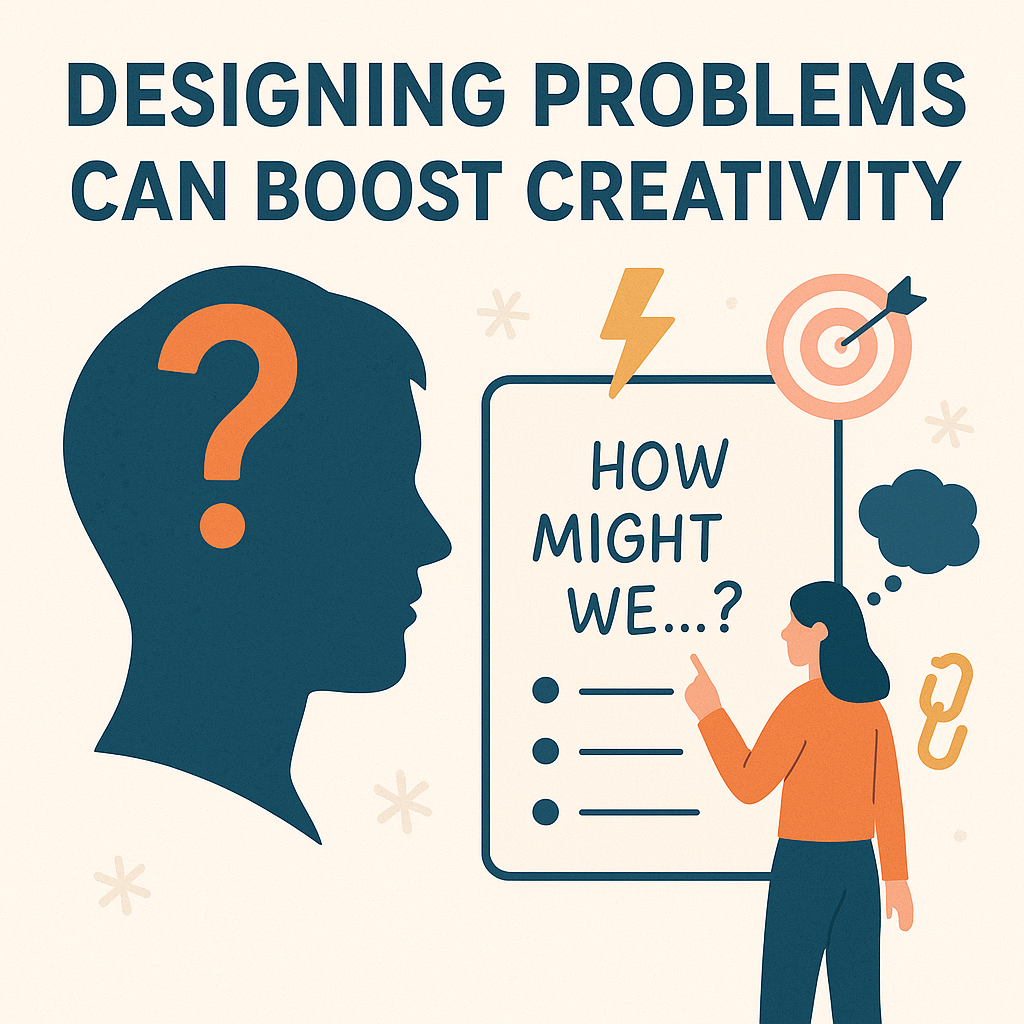
designing problems—not just solving them—can significantly boost creativity. This process is known as “problem framing” or “problem finding”, and it’s a foundational skill in creative thinking and innovation. Here’s why:
Why Designing Problems Boosts Creativity
1. Encourages Deep Understanding
When you design a problem, you must explore the system, context, and needs.
This leads to more insightful and relevant challenges.
2. Shifts from Reactive to Proactive Thinking
Solving existing problems often limits thinking to known solutions.
Designing new problems encourages thinking about possibilities, not just fixes.
3. Expands Solution Space
A well-framed or newly designed problem opens up more creative avenues.
Example: Instead of “How do we reduce call center wait times?” → “How might we improve customer communication overall?”
4. Drives Innovation from the Root
Innovators often redefine the problem first (think Steve Jobs, Elon Musk, design thinkers).
By asking better questions, you unlock novel opportunities.
5. Promotes Ownership and Intrinsic Motivation
People are more creative when they work on problems they’ve helped define.
It becomes their challenge, not just a task.
🛠️ Techniques to Boost Creativity by Designing Problems
| Technique | How it Helps |
|---|---|
| “How Might We” Questions | Reframes challenges to be open-ended and optimistic |
| Assumption Busting | Identifies and questions hidden assumptions in current problem definitions |
| Reframing Matrix | Looks at the problem from multiple perspectives (e.g., customer, competitor, technology) |
| User Journey Mapping | Finds unmet needs or hidden friction points to turn into problem statements |
| Analogical Thinking | Uses unrelated domains to reimagine a problem (e.g., “How would Netflix solve this?”) |
📌 Real-World Example
Airbnb didn’t just solve “How do we find hotels faster?”
They designed a new problem: “How do we make staying in a stranger’s home feel safe, easy, and appealing?”