

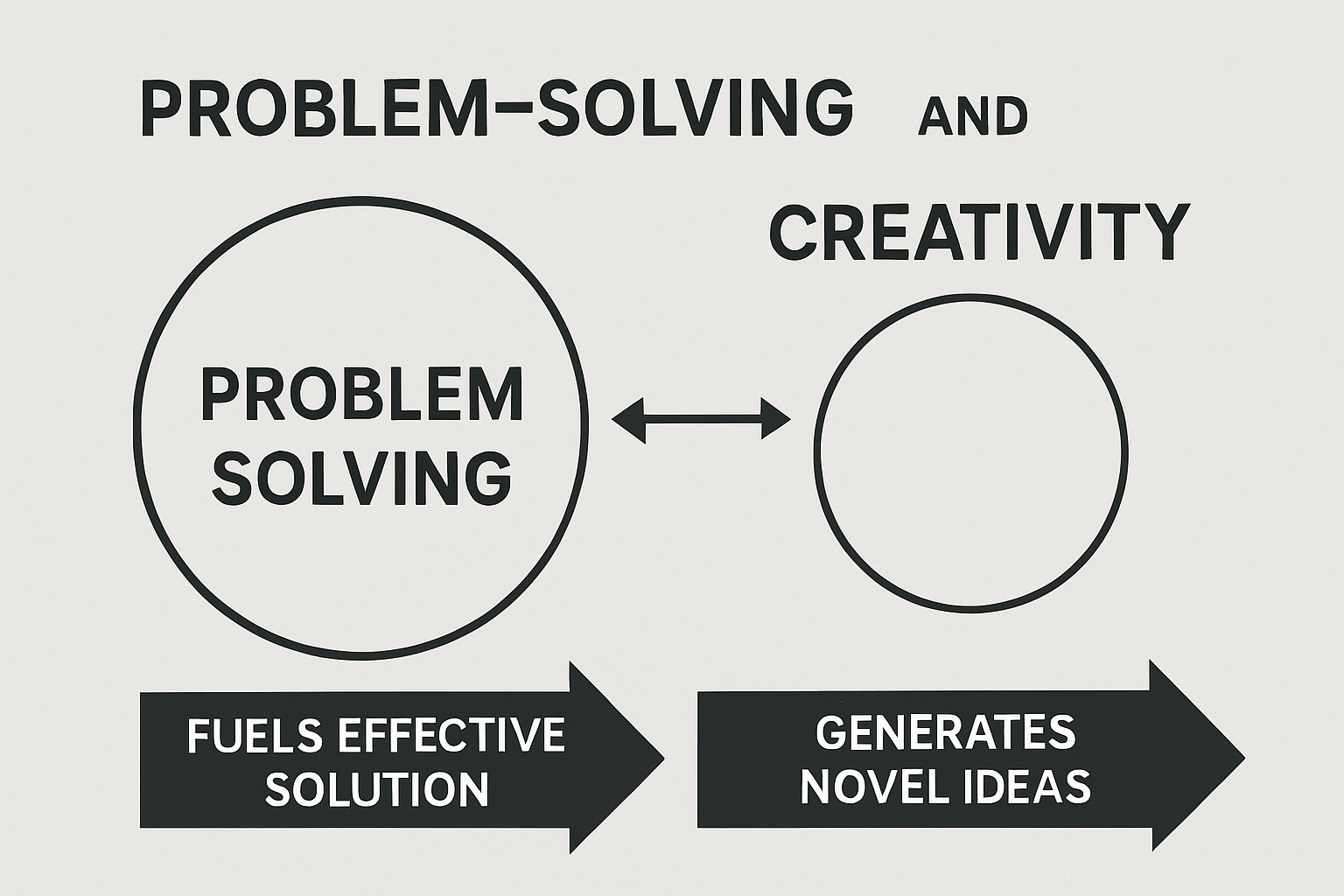
Problem-solving and creativity are deeply interconnected—creativity fuels effective problem-solving, and problem-solving is often the context where creativity is
most needed. Here's how they relate:
Creativity as a Driver of Problem-Solving
- Generates novel ideas: Creativity helps you move beyond obvious or conventional solutions.
Breaks mental blocks: It allows for out-of-the-box thinking, especially when standard approaches fail.
Enhances flexibility: Creative thinkers can reframe
problems and approach them from multiple angles.
Problem-Solving as a Trigger for Creativity
- Sets the stage: A clear, challenging problem often stimulates creative effort.
- Constrains with purpose: Paradoxically, limitations and constraints in problem-solving can push people to think more creatively.
- Encourages iteration: The trial-and-error nature of problem-solving encourages creative experimentation.
Here’s a simple 5-step framework that combines creativity and problem-solving into a single, repeatable model you can apply in any context—work, education, design, or daily life:
| Step | Description | Focus |
|---|---|---|
| C – Clarify the Problem | Define the issue clearly. Ask: What’s really the challenge? | Problem-Solving (Analytical) |
| R – Reframe with Questions | Look at it from different angles. Ask “What if?”, “Why not?”, “How might we?” | Creativity (Reframing) |
| E – Explore Ideas | Brainstorm without judgment. Go for quantity, not quality—yet. | Creativity (Divergent Thinking) |
| A – Assess and Select | Evaluate ideas for feasibility and impact. Narrow it down. | Problem-Solving (Convergent Thinking) |
| T – Test & Try | Prototype or test the solution on a small scale. Learn from feedback. | Creative Experimentation |
| E – Evolve | Refine, iterate, or pivot. Return to earlier steps if needed. | Adaptive Thinking |