

AI-Resistant Skills and Jobs: Future-Proofing Your Career with Game-Based Learning
As Artificial Intelligence (AI) continues to reshape industries, many professionals are asking the same question: Which skills and jobs will remain valuable in an AI-driven world? While AI excels at automation, data processing, and pattern recognition, there are human abilities it cannot fully replicate. These AI-resistant skills are becoming the cornerstone of long-term career success.
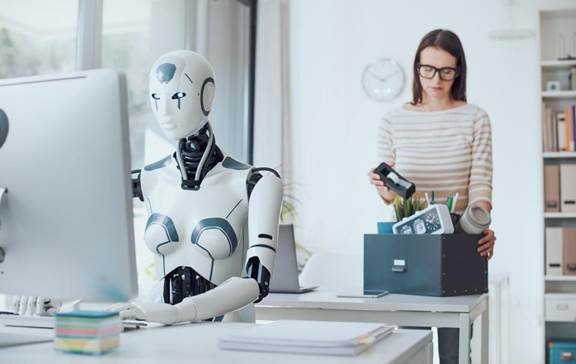
What Are AI-Resistant Skills?
AI-resistant skills are competencies that are difficult for machines to replace. They combine creativity, emotional intelligence, and problem-solving in contexts where human judgment is essential. By focusing on these areas, learners and professionals can future-proof their careers.
Key AI-Resistant Skills
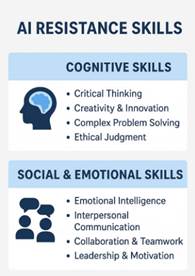
- Creativity & Innovation — true creativity requires imagination, storytelling, and design thinking.
- Critical Thinking & Problem-Solving — humans navigate ambiguity and make ethical decisions.
- Emotional Intelligence (EQ) — leadership, empathy, and relationship-building remain uniquely human.
- Collaboration & Communication — cultural sensitivity and persuasion come from people, not algorithms.
- Adaptability & Lifelong Learning — staying relevant requires continuous upskilling in evolving industries.
AI-Resistant Jobs
While some jobs will transform under AI, others will thrive because they rely on uniquely human skills:
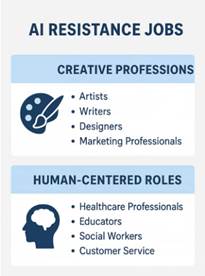
- Healthcare professionals — human care, trust, and empathy are irreplaceable.
- Educators & Trainers — teaching, mentoring, and inspiring learners need a human touch.
- Creative roles — artists, designers, writers, and game developers rely on innovation and storytelling.
- Leadership & Management — decision-making, strategy, and vision cannot be fully automated.
- Skilled trades — electricians, carpenters, and chefs depend on hands-on expertise and problem-solving.

Categories of AI-Resistant Jobs
- Cognitive-skills-based jobs
- Social Science Researcher
- Policy Analyst
- Professional Ethics Specialist
- Business Strategist / Futures Analyst
- Social & Emotional-skills-based jobs
- HR Manager
- Coach / Trainer
- Family Counselor / Psychologist
- NGO Leader
- Learning & Adaptability-skills-based jobs
- Digital Transformation Specialist
- Organizational Change Manager
- Learning Experience Designer
- New Technologies Researcher
- Interdisciplinary & Creative-skills-based jobs
- UX / UI Designer
- Startup Entrepreneur
- Writer / Storyteller
- Educational Game Designer
- Technical-complementary-skills-based jobs
- AI Ethicist Specialist
- Human Data Analyst
- Cybersecurity Manager
- Educational Technology Specialist
How Game-Based Learning Builds AI-Resistant Skills
Traditional training often struggles to engage learners. Game-based learning combines interactivity with real-world problem scenarios, helping learners build critical thinking, creativity, and adaptability in engaging ways.
- Immersive scenarios foster decision-making practice.
- Gamified challenges encourage problem-solving under pressure.
- Collaboration features strengthen teamwork and communication.
- Continuous feedback loops build adaptability and resilience.
Future-Proof Your Career
AI will not replace all jobs, but it will change how we work. Those who invest in AI-resistant skills today will stand out in tomorrow’s job market. With game-based learning platforms, learners can train the abilities machines cannot duplicate—keeping their careers relevant, impactful, and future-ready.
References
- World Economic Forum (2023). Future of Jobs Report 2023. weforum.org
- McKinsey & Company (2022). The Future of Work After COVID-19. mckinsey.com
- OECD (2021). AI and the Future of Skills, Volume 1. oecd.org
- Harvard Business Review (2022). The Skills Companies Need Most in 2022 – And How to Learn Them. hbr.org
- PwC (2021). Will Robots Really Steal Our Jobs? pwc.com